5 days, 4 nights
Ltc4.9(12)
4 Nights 5 Days Andaman LTC Tour Package
Port BlairHavelockNeil Island
- Explore the historic Cellular Jail and learn about its connection with India's freedom movement.
Price on request
Are drones allowed in Andaman? Learn about drone rules, permissions, airport restrictions, flying zones and what tourists should check before takeoff.
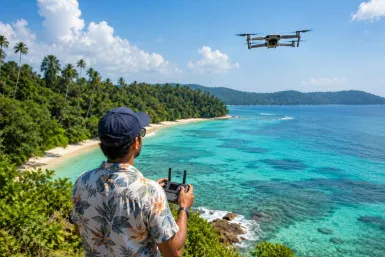
But there is an important question to answer before packing your drone: Are drones allowed in Andaman?
The short answer is: not everywhere and not automatically. Carrying a drone and flying a drone are two different things. Whether you can operate it depends on the drone, the airspace zone, the exact location, current restrictions and any permission that may apply.
India's drone rules use airspace zones, and the status of an area can change. This is especially important in Andaman and Nicobar Islands because the region has airports, defence and security interests, protected areas and other locations where normal tourist assumptions may not apply.
So, if you are travelling with a drone, do not follow an old travel video or assume that a quiet beach is automatically safe for flying. Check the current position before every flight.
Yes, drone operations can be possible in Andaman, but there is no blanket permission to fly a drone anywhere you want.
The important point is the location and the current airspace status.
Under India's drone framework, airspace is divided into green, yellow and red zones. In general:
The airspace status can also change, and temporary restrictions may be introduced. This means checking the current status is not something to do only once when planning your holiday. It should be checked before the actual flight.
For this reason, drone rules in Andaman should be understood as a combination of India's general drone regulations and location-specific restrictions.
Bringing a drone to Andaman and actually operating it are separate questions.
A tourist may be able to transport a drone to the islands, but that does not give permission to fly it. Before travelling, check the latest airline baggage instructions, battery requirements, airport security rules and applicable local requirements.
For the drone itself, also check whether it meets the current regulatory requirements applicable to that aircraft.
This distinction is important for anyone searching: can tourists fly drones in Andaman? Carrying the equipment does not mean every location is available for aerial photography.
If you are travelling by air, keep the drone and batteries packed according to your airline's latest instructions. Do not rely on what another traveller was allowed to carry on an earlier trip.
India has a national regulatory framework for drone operations. Travellers do not need to understand every legal section, but they should know the basic principles before planning drone flying in Andaman and Nicobar.
Indian rules classify drones according to their weight. The category matters because different requirements can apply to different types of drones.
This is why a traveller should not simply say, "My drone is small, so no rules apply."
A small consumer drone can still be subject to airspace restrictions, safety requirements and location-specific instructions.
The current airspace status is one of the most important things to check before operating a drone.
The location on the map matters. A place that looks open and isolated may still fall within controlled or restricted airspace.
Where an operation is permitted, the pilot must still follow the applicable operating conditions.
These can include requirements relating to altitude, visual line of sight, safe operation and other flight conditions.
Because drone rules and procedures can change, travellers should always check the latest requirements before flying rather than depending on an old checklist.
Sometimes yes, depending on the airspace and location.
You should not assume that a tourist drone is automatically exempt from permission requirements.
A useful way to think about Andaman drone permission is:
| Situation | What You Should Do |
|---|---|
| Green zone | Check the current map and applicable rules before flying |
| Yellow zone | Obtain the required prior permission |
| Red zone | Do not fly unless the required approval is obtained |
| Temporary restriction | Do not fly while the restriction applies |
| Sensitive location | Check with the relevant authority before considering any flight |
| Private or event location | Obtain any additional permission required by the property or organiser |
The important distinction is that drone permission in Andaman may involve more than the national airspace map.
A location may have additional security, administrative, environmental or event-related restrictions.
Do not treat a green airspace indication as permission to ignore other applicable laws or local instructions.
There is no sensible reason to create a fixed internet list of every place where drones cannot fly because restrictions can depend on the current airspace map and other local conditions.
Instead, travellers should pay particular attention to these types of locations.
Airports are one of the most important areas to check.
Port Blair's Veer Savarkar International Airport is an operational airport, so travellers should not fly a drone around the airport simply because they are outside the terminal or cannot see an aircraft nearby.
Airport-related restrictions can extend beyond the runway itself.
This is why Andaman airport drone restrictions should always be checked before planning aerial photography around Port Blair.
If Port Blair is part of your holiday, you can also review the existing Andaman travel packages covering Port Blair and other islands before planning your sightseeing.
Andaman has important defence and strategic interests. Areas connected with defence installations, military facilities and other sensitive locations should never be treated like ordinary tourist photography spots.
If a location appears restricted or security personnel give an instruction, do not launch the drone.
Wildlife and protected areas can have additional restrictions.
Do not assume that an attractive forest, mangrove area or wildlife location is suitable for drone photography.
If your holiday includes nature-based sightseeing, plan the trip first and check the drone restrictions separately.
Even when the airspace itself permits drone operation, flying directly over people creates a separate safety concern.
Avoid launching above:
A drone should never be treated as a harmless toy when people are below it.
A beach is not automatically a legal drone-flying location.
This is one of the common mistakes made by tourists searching for drone photography in Andaman.
A beautiful beach may look like the perfect place for an aerial shot, but you still need to check:
If all applicable conditions are satisfied, operate only within the permitted limits.
If there is any doubt, keep the drone packed away and enjoy the beach from the ground.
For travellers deciding which beaches and islands to include, the Andaman Islands travel guide can also help with general destination planning.
Do not assume that being on an island automatically makes drone flying easier.
Havelock, also known as Swaraj Dweep, and Neil Island, also known as Shaheed Dweep, are popular tourist destinations, but the same basic rule applies: check the exact location and current restrictions before flying.
If you are planning Havelock as part of your trip, you can review an existing Andaman itinerary covering Havelock and Port Blair to understand how island transfers and sightseeing can fit into your holiday.
Similarly, travellers interested in including Neil Island can look at an existing Andaman package covering Port Blair, Havelock and Neil Island for general itinerary planning.
These pages are useful for planning the holiday itself, but they should not be treated as permission to fly a drone at any particular attraction.
Use this simple checklist every time.
| Check | Why It Matters | What You Should Do |
|---|---|---|
| Drone category | Different requirements can apply | Know the weight and type of your drone |
| Airspace zone | Determines whether additional permission is needed | Check the current airspace map |
| Airport proximity | Airport operations require extra caution | Do not assume distance from the terminal means it is safe |
| Local restrictions | Some locations have separate controls | Check with the relevant authority |
| Temporary restrictions | Restrictions can change | Recheck before flight |
| Weather | Wind and rain can affect safe operation | Follow safe operating limits |
| People nearby | Reduces safety risk | Avoid flying over crowds |
| Sensitive locations | Security rules may apply | Do not fly near restricted facilities |
| Documents | May be needed to demonstrate compliance | Carry relevant records and approvals |
| Flight conditions | Safe operation matters even in permitted zones | Follow all current requirements |
If you want to use your drone during your holiday, follow these steps.
Do not use a blog, YouTube video or social media post from several years ago as your main source of information.
Drone regulations can change.
The location on the map matters. Check the airspace status for the actual place where you intend to launch the drone.
Airspace permission is not necessarily the only permission that matters. Check whether the location has separate restrictions.
If the area requires approval, obtain it before operating the drone.
Do not fly first and ask for permission later.
Island weather can change. Strong wind or rain can make flying unsafe even when the airspace is otherwise available.
Operate only within the permitted limits and maintain the required visual awareness of the aircraft.
Do not use a drone to record people in private situations or deliberately capture areas where people reasonably expect privacy.
Flying in a restricted area can lead to enforcement action and other consequences depending on the applicable law, location and circumstances.
The exact consequence should not be reduced to one fixed penalty amount because different violations can involve different rules and authorities.
The safest approach is simple:
A few minutes of checking is far better than risking your holiday, equipment or legal trouble.
Photographers and vloggers often want shots of beaches, boats, resorts and sunsets from above. That is understandable.
But beautiful scenery does not create an exception to aviation rules.
If you are creating commercial content, filming an event or producing professional aerial footage, additional approvals may also be relevant depending on the activity.
For ordinary holiday photography, the safest approach is to first establish that the flight itself is permitted and then follow the operating conditions.
If you cannot legally fly, use a normal camera, action camera or phone instead. You can still create excellent travel content without taking an unnecessary risk.
Size does not remove airspace restrictions.
An empty beach can still be inside restricted or controlled airspace.
That does not prove the flight was legal or that the same conditions apply today.
Other restrictions may still apply.
Airspace restrictions can change, and temporary restrictions may be introduced. Check before the flight.
Do not do this. If permission is required, obtain it before operating.
A drone should be an optional part of your holiday, not the reason for choosing a particular island.
Andaman Bliss offers itineraries covering destinations such as Port Blair, Havelock and Neil Island. You can review the available Andaman tour packages and choose an itinerary based on the places you want to visit rather than planning the entire holiday around drone footage.
For example, families looking for a shorter island holiday can consider the existing 4 Nights 5 Days Andaman Family Tour, while travellers wanting Port Blair, Havelock and Neil Island can consider a longer 6 Nights 7 Days Andaman Family Package.
These packages can help with general trip planning, but they do not mean drone flying is automatically permitted at the listed attractions. Drone permission must always be checked separately.
Drone use can be permitted in some circumstances, but drones are not automatically allowed everywhere in Andaman. The current airspace zone, location-specific restrictions, drone requirements and any required permissions must be checked before every flight.
Tourists may be able to operate a drone where the applicable rules permit it, but being a tourist does not create a special exemption. Check the current airspace map, location restrictions and any required permission before flying.
It depends on the airspace and location. Some zones require prior permission, while other operations may be allowed subject to applicable rules and pre-flight checks. Additional local restrictions may also apply.
Carrying a drone and flying one are different matters. Before travelling, check your airline's current baggage and battery requirements as well as airport security instructions. Carrying the drone does not permit you to operate it after reaching Andaman.
Do not assume that all of Havelock is available for drone flying. Check the current airspace status and any local restrictions for the exact launch location before operating. Conditions can differ between locations and may change over time.
Drone photography is possible only when the flight is legally permitted and all applicable operating conditions are followed. Beautiful scenery does not create an exception to aviation or local restrictions. Commercial filming may also involve additional permission requirements depending on the activity.
Not automatically. A beach may still fall within controlled or restricted airspace or be affected by another local restriction. Check the exact location before launching, and avoid flying over crowds or people even where the airspace permits drone operations.
Restrictions can apply around airports, sensitive defence or security locations, protected or environmentally sensitive areas and other restricted airspace. Temporary restrictions may also apply. Rather than relying on a fixed online list, check the current airspace map and location-specific instructions before flying.
Check your drone's applicable requirements, the current airspace zone, airport-related restrictions, local restrictions, temporary notices, weather conditions and any required permission. Also make sure you can operate the drone safely within the applicable limits.
Possibly, but only if the flight itself is permitted and you follow all applicable requirements. Commercial or professional filming can involve additional permissions depending on the location and nature of the shoot. Having a camera or YouTube channel does not create an exemption from drone rules.
Andaman offers plenty of beautiful views, but a drone flight should never be based on the assumption that an open beach means open airspace.
The most important rule is simple: carrying a drone does not mean you can fly it anywhere. Check the latest applicable airspace status, location restrictions and permissions before every flight. If the rules are unclear, do not take off.
For the rest of your holiday, Andaman Bliss can help you plan an Andaman trip around Port Blair, Havelock, Neil Island and other destinations according to your travel plans.
Contact us to discuss your Andaman itinerary and travel requirements before your trip.
Co-founder & Director
Navin Kumar is part of the Andaman Bliss island team — Director.
40 articles by this authorReady-made Andaman itineraries that cover the places in this guide.
5 days, 4 nightsPort BlairHavelockNeil Island
Price on request
 4 days, 3 nights
Port BlairHavelock
Starting from
₹12,000
starting price, single occupancy
 7 days, 6 nights
Port BlairHavelockNeil Island
Price on request
 6 days, 5 nights
Port BlairHavelockNeil Island
Price on request